



Introduction
Egg freezing (oocyte cryopreservation) success rates vary significantly based on biological and technical factors. Key metrics include the likelihood of eggs surviving thawing, fertilizing, developing into viable blastocysts, and ultimately resulting in a live birth. Age at freezing and the number of eggs stored are the strongest predictors of success, with younger eggs (retrieved before age 35) having markedly higher viability. We will go through all this in the information below.
Post-freezing procedures: From egg to live birth
After thawing, eggs must undergo several steps to achieve a pregnancy:
- Thawing and fertilization: Survival rates post-thaw range from 85–95% for eggs frozen via vitrification. Fertilization success with ICSI (intracytoplasmic sperm injection) is ~70–80% for younger women but declines with age.
- Blastocyst development: Only 30–50% of fertilized eggs develop into blastocysts (day 5–6 embryos). This rate drops sharply with age:
- <35 years: ~50% blastocyst formation
- 35–37 years: ~40%
- ≥38 years: ~20–30%
- Euploidy screening: Even blastocysts may have chromosomal abnormalities. For women <35, ~60% are euploid (genetically normal), falling to ~30% by age 40. This is not offered in all laboratories and is optional.
- Embryo transfer: Only genetically normal blastocysts are transferred, with live birth rates per transfer ranging from 50–70% depending on maternal age and embryo quality.
Eggs from a younger woman tend to have higher mitochondrial integrity and fewer chromosomal errors, improving blastocyst formation and implantation potential. For example, a 30-year-old with 20 mature eggs has a ~90% chance of at least one live birth, while a 40-year-old with the same number has <30%.
The “20 egg” benchmark: Evidence from predictive models
A 2017 study developed a model to predict live birth probabilities based on age and eggs frozen. The key assumptions were:
- 95% thaw survival for women <36; 85% for ≥36.
- Age-specific blastocyst formation and euploidy rates.
- 60% live birth rate per euploid blastocyst transfer.
Results:
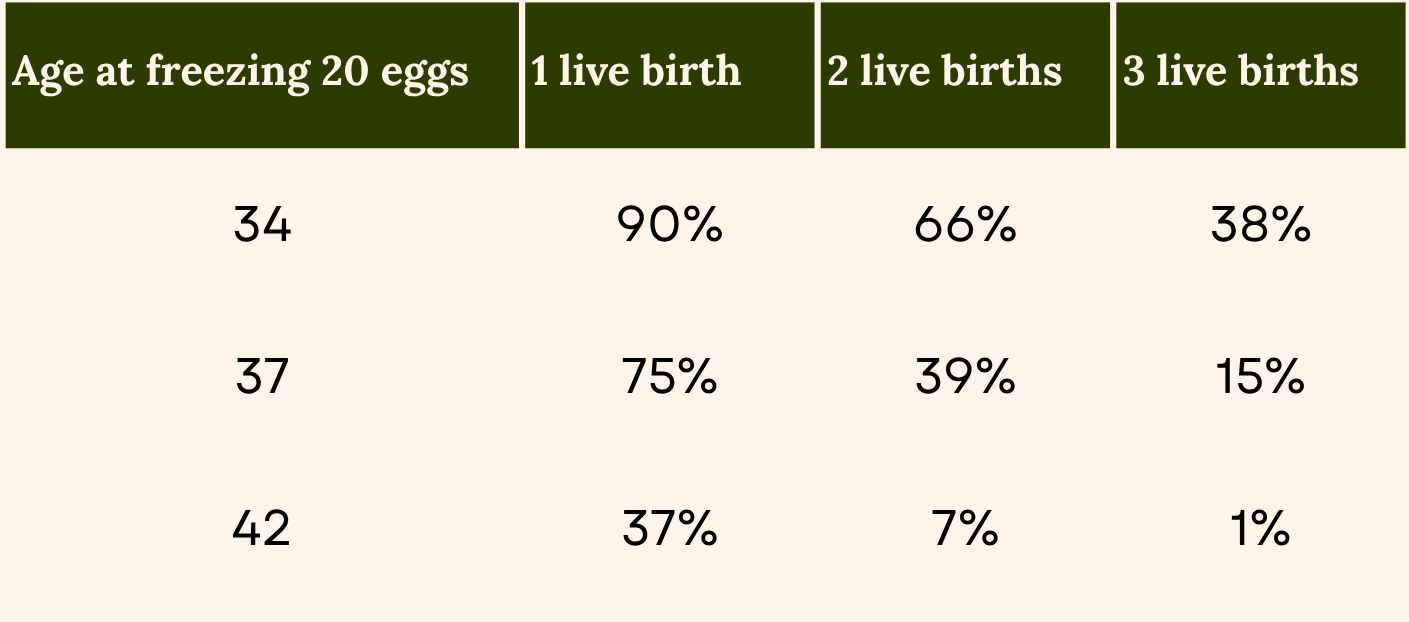
The table above shows the percentage of likelihood to have one, two, or three live births if 20 eggs were frozen.
Additional factors influencing success
- Sperm quality: Poor sperm morphology or DNA fragmentation reduces fertilization and blastocyst rates.
- Uterine health: Endometrial receptivity at transfer is critical. Frozen embryo transfers (FETs) often outperform fresh transfers due to better hormonal synchronization.
- Lab expertise: Blastocyst culture and vitrification protocols vary; high-performing clinics report 10–20% higher success rates.
- Lifestyle and medical history: Conditions like PMOS (previously PCOS), endometriosis, adenomyosis, obesity, and smoking further impact outcomes.
Summary
Success with frozen eggs hinges on age at retrieval, number of mature eggs stored, and clinic-specific protocols. While 20 eggs provide a reasonable safety net for younger patients, older individuals may need more aggressive retrieval cycles or additional interventions (e.g., PGT-A screening). Advances in vitrification and embryo selection continue to improve outcomes, but individualized counseling remains essential.
References
https://pubmed.ncbi.nlm.nih.gov/28166330/


